
UAE Foundations: A Structured Approach to Asset Management & Succession
A Practical Guide to Private Wealth Structuring
By KCM Consultants
Published 20 June 202611 minDownload PDF
The foundation structure has rapidly emerged as a cornerstone of the UAE’s private wealth ecosystem. This guide provides a practical overview of the foundation structure, its key features, participants, and mechanics, followed by a comparative analysis of the three UAE jurisdictions where foundations can be established: ADGM, DIFC, and RAK ICC.
Introduction
Since the Abu Dhabi Global Market (ADGM) pioneered the UAE’s first foundation framework in 2017[1], followed by the Dubai International Financial Centre (DIFC) in 2018[2], foundations have become an established part of the UAE private-wealth landscape. ADGM described its regime as designed to manage private wealth, safeguard assets, and enhance succession planning[1].
Combining the governance discipline of a corporate entity with the protective features of a trust, the UAE foundation offers families a flexible, private, and tax-efficient vehicle for asset protection, succession planning, and intergenerational wealth transfer.
What is a Foundation?
Figure 1 · How a UAE foundation is structured
Read this before the definitions below. Four roles sit around the foundation itself: the founder puts assets in, the council runs it, the guardian watches the council, and the beneficiaries receive what the by-laws allow.
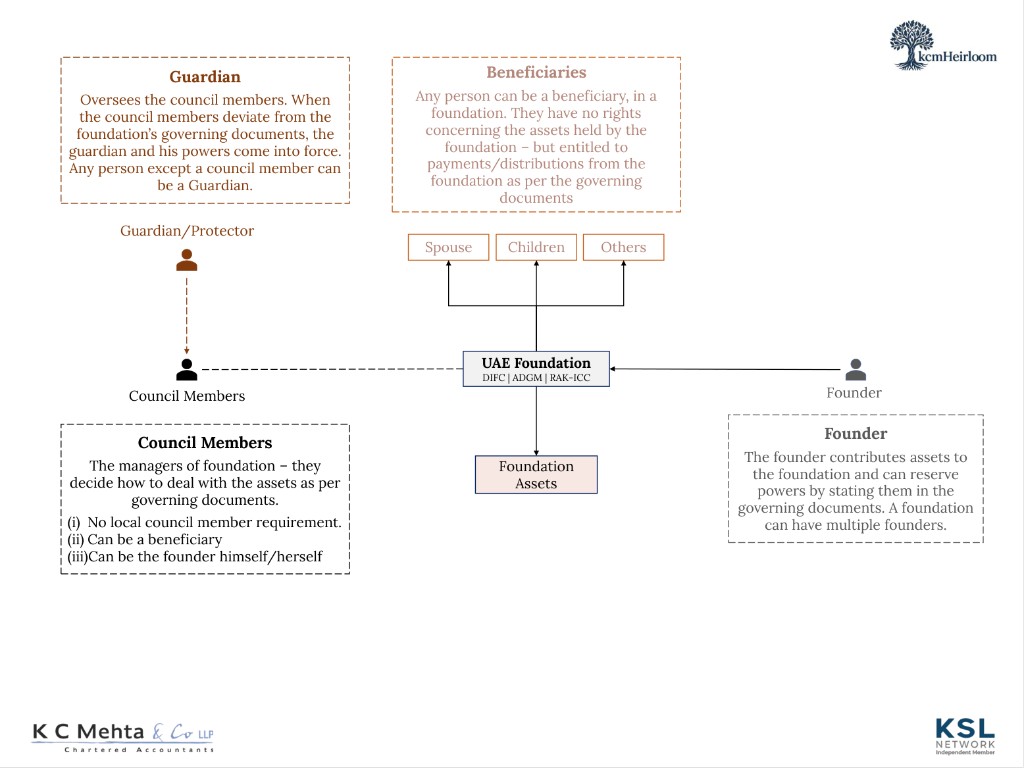
How to read this diagram
- Founder(s) transfer assets into the foundation at the top.
- Council manages day-to-day operations like a board.
- Guardian supervises the council against the charter and by-laws.
- Beneficiaries receive distributions; they do not own foundation assets.
Core Concept
Those of us familiar with trusts will find the foundation concept intuitive; both structures hold and manage assets for the benefit of designated persons. However, unlike a trust, where a trustee holds legal title on behalf of beneficiaries, a foundation is an independent legal entity that holds assets in its own name[3]. The founder(s) contribute assets to the foundation, and once contributed, those assets belong to the foundation itself[3].
The beneficiaries (typically family members) are entitled to benefit from the foundation but hold no ownership interest in it[3]. Day-to-day management is carried out by the Council, which must consist of at least two Councillors; the Founder can also be appointed as Councillor[4].
Key Participants
The same five roles from Figure 1, defined in full.
Founder(s)
Contribute assets to the foundation. The Charter or By-laws may reserve broad powers to the Founder, including amending governing documents, directing investments, and appointing or removing Councillors and the Guardian[3]. A foundation can have multiple founders.
Council
Carries out day-to-day management, much like a board of directors. An ADGM Foundation must have a Council of at least two Councillors; the Founder can also be appointed as Councillor[4].
Guardian
Oversees the Council and ensures compliance with the charter and by-laws. Under ADGM Foundations Regulations, a Guardian may be a Founder or Beneficiary, but neither a Councillor nor a sole Beneficiary may be appointed as Guardian[3]. ADGM incorporation guidance states that a Guardian may not be a Founder[4]; practitioners should reconcile this regulations-versus-guidance conflict with counsel. Appointment is optional while any Founder is alive and becomes compulsory upon the death of the last standing Founder[4][3].
Registered Agent
A professional consultant responsible for statutory compliances.
Beneficiaries
Any person can be a beneficiary. No Beneficiary has rights in specie against Foundation Assets, notwithstanding any foreign statute or law to the contrary[3]. They are entitled to payments and distributions as per the governing documents.
The key feature, at the cost of repetition, is that a foundation is an independent legal entity that holds assets in its own name and in its own right[3]. While not strictly a hybrid of a company and a trust, it shares functions and mechanisms with both. What sets it apart is its unique position: it has no shareholders, no members, and no beneficial ownership in the traditional sense. It is a so-called orphan structure. This makes it particularly suited for long-term, purpose-driven asset holding.
Why Use a UAE Foundation?
Just like it was with private trusts, the real question is “When would you really want to use a UAE foundation?” We have endeavoured to respond to this comprehensively.
With foundations, there is an additional question, “Why would I use a foundation over a private trust?” For this question, the answer is pretty simple. It is totally up to you. If a jurisdiction offers you a choice between a trust and a foundation, you can choose either, and fundamentally there would be no big impact on your estate plan. It is like deciding between a water bottle and a water pouch; these are essentially the same things serving the exact same purpose, except that they look and feel different. However, a trust has no separate legal identity, whereas foundations have a separate legal identity. Further, some jurisdictions offer only foundation structures (and do not recognize trusts) whereas others have it the other way around, so it is not really a choice in such cases.
Continuity Meets Customisation
Avoidance of the Probate Process
Succession through personal estates can involve court processes that interrupt continuity of asset management. The mechanics depend on applicable UAE and home-country law and should be confirmed with counsel.
Under ADGM law, assets transferred to a Foundation become the Assets of the Foundation with full legal and beneficial title and are no longer the property of the Founder[3]. Because ownership vests in the foundation entity, those assets may continue to be managed through the foundation’s governance structure rather than passing through the founder’s personal estate.
Flexibility
Foundation regulations set the structural and legal framework while allowing founders flexibility to shape internal workings. Key matters, such as council powers, the founder’s reserved powers, composition of the council, the guardian’s powers, distribution mechanisms, and amendment procedures, are provided as default rules, subject to modification through the charter and by-laws.
A foundation has two constitutional documents, the charter and by-laws, analogous to a company’s memorandum and articles. Subject to limited regulatory constraints, governance and decision-making provisions may be placed in either, offering significant drafting flexibility.
The Estate Planning Fundamentals
Tax Transparency
Where a UAE family foundation meets the conditions in Federal Decree-Law No. 47 of 2022 and the FTA approves an application, it may be treated as an Unincorporated Partnership and not taxed in its own right[5][7][8]. Its income is attributed to, and taxed in the hands of, the beneficiaries as if earned personally[5][7].
In the UAE, for individuals, personal investment income, real estate income, wages, and business income up to AED 1 million turnover are exempt from Corporate Tax[6][7]. Accordingly, where beneficiaries are individuals, income from securities and real estate held through the foundation may effectively not be taxed.
Ring-fencing of Assets
Perhaps the most compelling advantage of a UAE foundation is the legal wall it erects between the founder’s personal estate and the foundation’s assets.
Under ADGM Foundations Regulations, once assets are transferred to a Foundation, they become the Assets of the Foundation with full legal and beneficial title and are no longer the property of the Founder[3]. This means they are ring-fenced from the founder’s personal estate as a matter of ADGM law.
Interplay with Foreign Laws
Overriding Foreign Laws
Under ADGM Foundations Regulations, a transfer or other disposition of property to an ADGM Foundation shall not be void, voidable or liable to be set aside by reference to a foreign rule of forced heirship or any other law of a foreign jurisdiction[3]. Comparable override provisions in DIFC and RAK ICC should be verified against current primary law with counsel.
This is a strongly worded statutory mandate under ADGM law. Whether and how similar protection applies in other UAE foundation jurisdictions requires jurisdiction-specific advice.
Escape from Forced Heirship
Forced heirship regimes grant fixed shares to heirs, limiting testamentary freedom. Cross-border interactions between home-country heirship rules and UAE foundation law are fact-specific and should be analysed with counsel.
Under ADGM law, assets transferred to a Foundation become the Assets of the Foundation and are not the Assets of any Beneficiary until distributed[3]. No Beneficiary has rights in specie against Foundation Assets, notwithstanding any foreign statute or law to the contrary[3]. ADGM also provides that transfers to an ADGM Foundation shall not be set aside by reference to foreign forced-heirship rules[3], enabling distributions to be governed by the charter and by-laws subject to applicable law.
Selecting the Right Jurisdiction
ADGM introduced the UAE’s first foundation regime[1], with DIFC following in 2018[2]. The table below compares factors across ADGM, DIFC, and RAK ICC. ADGM cells are grounded in primary sources cited in this guide; DIFC and RAK ICC entries are per KCM’s guide and should be verified with counsel.
| Factors | ADGM | DIFC | RAK-ICC |
|---|---|---|---|
| Legal System | Common Law | Per KCM guide — verify with counsel | Per KCM guide — verify with counsel |
| Minimum Initial Capital | $100 (any kind of asset)[3] | Per KCM guide — verify with counsel | Per KCM guide — verify with counsel |
| Statutory fees on incorporation | USD 200 (application for registration)[3] | Per KCM guide — verify with counsel | Per KCM guide — verify with counsel |
| Tax transparency [5] | Federal UAE regime: application required; not automatic[8] | Federal UAE regime: application required; not automatic[8] | Federal UAE regime: application required; not automatic[8] |
| Reserving powers for founders | Broad list of powers with no time limit of reservation[3] | Per KCM guide — verify with counsel | Per KCM guide — verify with counsel |
| Privacy & Confidentiality | Per KCM guide — verify with counsel | Per KCM guide — verify with counsel | Per KCM guide — verify with counsel |
| Ring-fencing — Clawback period | Per KCM guide — verify with counsel | Per KCM guide — verify with counsel | Per KCM guide — verify with counsel |
| Annual filing | Per KCM guide — verify with counsel | Per KCM guide — verify with counsel | Per KCM guide — verify with counsel |
| Risk of dissolution by authorities | Per KCM guide — verify with counsel | Per KCM guide — verify with counsel | Per KCM guide — verify with counsel |
| Migration and Conversion | Migration into ADGM permitted for qualifying overseas foundations[3] | Per KCM guide — verify with counsel | Per KCM guide — verify with counsel |
| Guardian Appointment | Optional while any Founder is alive; compulsory after last Founder’s death[4][3] | Per KCM guide — verify with counsel | Per KCM guide — verify with counsel |
Closing Remarks
The UAE foundation offers legal separation of assets from the founder’s personal estate, statutory ADGM protection against certain foreign heirship claims, and flexibility in how wealth is governed and distributed across generations — subject to jurisdiction-specific design and counsel review.
Three points to carry into the decision
Each draws directly on the analysis above.
Structure is Only as Strong as its Design
The choice of jurisdiction matters. ADGM, DIFC, and RAK ICC differ on confidentiality, reserved powers, filing obligations, and regulatory intervention; verify DIFC and RAK ICC particulars with counsel.
Charter vs. By-Laws: A Critical Decision
The allocation of provisions between the charter and the by-laws demands careful thought; a misstep here can cost future generations in time, money, or both.
Not Off the Shelf
A UAE foundation is not a product to be purchased off the shelf. It is a bespoke legal structure that demands careful design, precise documentation, and informed jurisdiction selection.
The families that benefit most from it are those that plan it well.
References
- Abu Dhabi Global Market, ADGM Proposes New Foundations Regime to Address Regional and Global Needs (31 May 2017).
- Dubai International Financial Centre, Foundations Law DIFC Law No. 3 of 2018 (enacted 14 March 2018; commenced 21 March 2018).
- Abu Dhabi Global Market, Foundations Regulations 2017.
- Abu Dhabi Global Market, Guidance – Incorporation of Foundation (2 September 2017).
- UAE Ministry of Finance, Federal Decree-Law No. 47 of 2022 on Taxation of Corporations and Businesses (Articles 16–17).
- Federal Tax Authority, Cabinet Decision No. 49 of 2023.
- Federal Tax Authority, Taxation of Family Foundations (Corporate Tax Guide CTGFF1) (5 June 2026).
- Federal Tax Authority, Family Foundations as an Unincorporated Partnership application via EmaraTax (10 March 2025).